
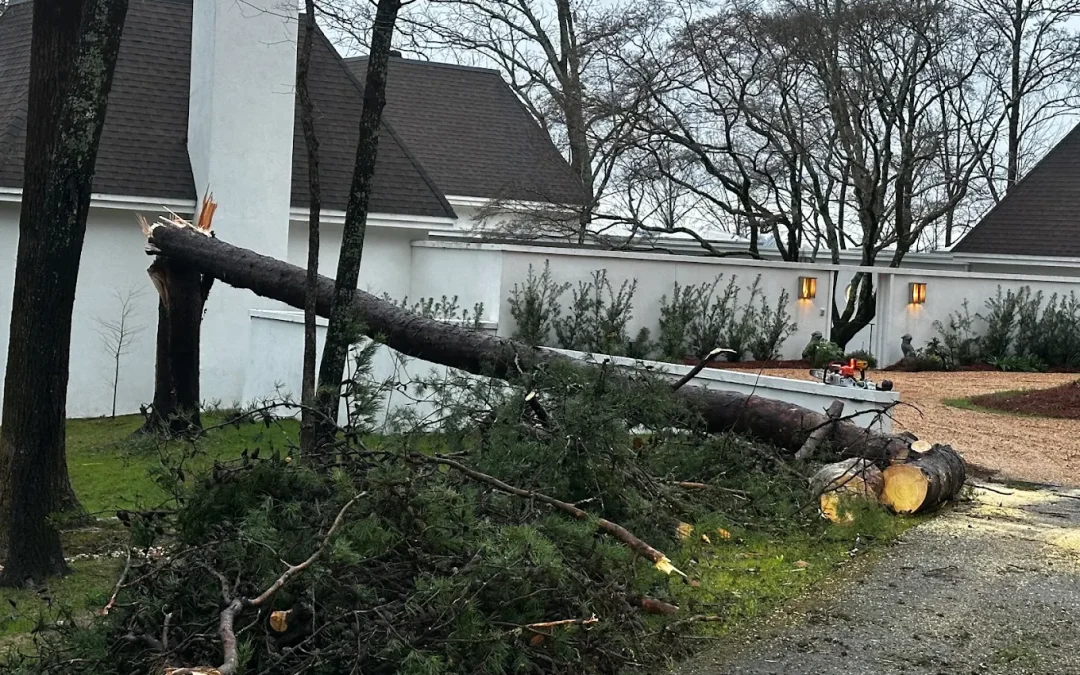
Short answer: usually only if the tree hit something. If a storm drops a tree on your house, garage, or fence, most Alabama policies will look at both the damage and the removal. If that same tree lands in your yard and hits nothing, you’re generally paying to haul it off yourself. And before you file either way, check your wind and hail deductible — in Alabama it’s usually a percentage of your dwelling limit rather than a flat amount, which means it can easily be larger than the removal itself.
The details are where this gets expensive, so here’s the longer version.
After a big storm I’ll get twenty calls in a day, and a good half of them start the same way. My insurance is going to cover this, right?
Sometimes. Usually not the way people expect. And I’ve watched more than a few homeowners spend a week waiting on an adjuster for a job their policy was never going to pay for.
I’m not an insurance agent and I can’t tell you what your policy covers — that’s between you and your carrier, and every policy is written a little differently. But I’ve been on the other end of a lot of these, and there are a few things worth knowing before you pick up the phone.
Does homeowners insurance cover a tree that fell in my yard?
Generally, no. The question that decides it is whether the tree hit something.
A healthy tree comes down in a storm and lands on your house, your garage, your fence, your shed — most policies will look at that. The same tree comes down and lands in the middle of your yard, hits nothing, and you’re paying to have it hauled off yourself. Even if it’s across your driveway and you can’t get your car out.
It feels backwards. The tree is just as down either way, and the work to get it out is the same work. But homeowners insurance is built to repair damage to property, and a tree lying in the grass hasn’t damaged anything the policy recognizes. Allstate puts it about as plainly as anyone: if the tree fell without causing damage to a structure, the policy likely won’t cover removing the debris.
The language you’re looking for in your own policy reads something like removal of fallen trees is excluded unless they damage covered property — meaning the dwelling itself or a detached structure like a garage or shed.
There’s an exception worth knowing: some policies will pay a small amount to clear a fallen tree blocking a driveway or a handicap ramp, even with no structural damage. It’s not universal and it’s not much. Worth asking about. Don’t count on it.
How much will insurance pay to remove the tree?
Here’s where people get surprised.
Say the tree did hit your house. The policy looks at repairing the house — that’s the big number, and that’s what the coverage is really for. But getting the tree itself off the house and hauled away usually falls under a separate debris removal provision. How much that’s worth depends entirely on how your policy is written, and there are two very different ways I see it done.
| How it’s written | What that means | Typical numbers |
|---|---|---|
| A flat cap | A set dollar amount per tree, and a ceiling for the whole event | Often around $500 per tree and $1,000 per incident |
| A percentage over your limit | Debris removal on top of your dwelling coverage limit | Commonly 5% over the limit of liability |
If you’ve got the flat cap, know now that it isn’t going to go far. Five hundred dollars does not get a mature water oak off a roofline. On a job where we’re setting a crane in a tight yard in Homewood with power lines in the picture, that number is a rounding error.
The percentage version is a different world. On a house insured for $325,000, five percent is real money — enough to cover the removal and then some.
Same storm, same tree, and the difference between those two policies is thousands of dollars out of your pocket. It’s one line, filed under debris removal. Go find out which one you’ve got before you need to know.
How does Alabama’s wind and hail deductible affect a tree claim?
This is the one I wish more homeowners knew before the storm instead of after.
In Alabama, most policies carry a separate wind and hail deductible, and it’s usually written as a percentage of your dwelling coverage rather than a flat dollar amount. Not a percentage of the claim — a percentage of the whole dwelling limit. It applies statewide, to tornadoes, straight-line winds, and thunderstorm hail. Down in Mobile and Baldwin County they stack a named-storm deductible on top; up here in Jefferson County you’re usually looking at somewhere in the 1% to 2% range.
Run the math on your own house. On a $300,000 dwelling limit:
- 1% is $3,000
- 2% is $6,000
- 5% is $15,000
That’s what you pay before the policy pays anything.
Now put that next to a tree removal. For a lot of the work we do, the whole job comes in under that deductible. Which means the claim gets you nothing, and you’ve spent a week waiting on an adjuster to tell you so. If you want a sense of the range, we wrote up what tree removal actually costs in Birmingham.
The number you need is on your declarations page, under Coverage A, and there’ll be a separate line for the wind/hail deductible next to it. Two minutes to look it up. Do it before storm season, not during. If you can’t find it, your agent or the Alabama Department of Insurance can point you at it.
None of that means don’t file. If a tree went through your roof, absolutely file — the structural repair is exactly what the policy is for and it’ll clear the deductible easily. But if it’s a tree down and some gutter damage, look at your deductible first. Sometimes the honest answer is that you’re better off just having it taken care of.
Will insurance cover a dead tree that fell?
Maybe not. Policies cover sudden accidents. They don’t cover things you let happen.
If a tree was rotting, hollow, half-dead, obviously leaning, and it finally came down in a thunderstorm, a carrier can look at that and call it a maintenance problem rather than storm damage. Same storm, same tree on the same roof, and the claim goes differently depending on what the tree looked like the week before.
I’m not saying every dead tree gets denied. Plenty don’t. But it’s the argument the carrier has available, and it’s the reason I tell people the same thing every fall: the cheapest version of this problem is the one you handle before it falls. A removal you schedule is a normal job on a normal day. A removal at 11pm with the tree resting on your bedroom is a different job at a different price, and now there’s a roof involved.
Nobody wants to spend money taking down a tree that hasn’t done anything yet. I get it. But that dead pine in the back corner isn’t going to get less dead. If you’re not sure what you’re looking at, that’s what a tree risk assessment is for.
My neighbor’s tree fell on my house. Who pays?
In most cases you file with your own carrier. That surprises people, and it feels unfair, but that’s typically how it runs. Your insurer may go after their insurer afterward to recover it. That part happens above your head.
Where it changes is negligence. If that tree was visibly dead and the neighbor had been told about it and did nothing, their liability coverage may come into it. That’s a conversation between two carriers and sometimes two attorneys, and it’s well outside what I do.
One thing I’d say: if you’ve got a neighbor’s dead tree leaning toward your house, put it in writing. A text message with a date on it. You’d rather have that and not need it.
What should I do right after a tree comes down?
Before anything else — if it’s on power lines or on a structure, keep everybody away from it and call the power company first. A limb resting on a service line is not a wait-and-see situation.
Then:
Take pictures before anything moves. More than you think you need. The tree, the damage, the whole scene, wide shots and close ups. Once we start cutting, that evidence is gone.
Do what’s reasonable to prevent more damage. Most policies expect you to — tarping an open roof, that kind of thing. Keep the receipts.
Call your carrier before you authorize a full cleanup, unless it’s an emergency and something’s actively unsafe.
Then call us. We’ll document what we find, photograph the work, and give you paperwork that makes sense to an adjuster. That’s the bulk of what storm cleanup looks like on our end. What we won’t do is tell you what your policy covers, because we don’t know and neither does anybody who hasn’t read it.
The short version
Hit a structure, probably covered. Fell in the yard, probably not. Removal is a separate line item from the repair, and how much you get for it depends on how your policy writes it — go look. And in Alabama, check your wind and hail deductible before you assume filing is worth anything, because it’s a percentage of your dwelling limit and it’s frequently bigger than the job.
If you’ve got a tree you’re not sure about, have somebody walk the property and look at it. That’s free, and it’s a lot easier to deal with a problem in October than in the middle of a March storm.
Get a free estimate → or call (205) 879-1263.
About the author. Carl Hess runs Evans Tree Service in Birmingham, Alabama, a family business that has been doing tree work in the Birmingham area since 1912. Carl’s experience is on the job and operations side — he is not a certified arborist. The company’s arborist work is handled by his sons, Andrew Hess and Evans Hess, both ISA Certified Arborists. Andrew also holds the ISA Tree Risk Assessment Qualification (TRAQ). Evans Tree Service works to ANSI A300 standards. You can meet the crew here.
This is general information about how homeowners policies commonly work in Alabama, not advice about your specific policy. Coverage, limits, and deductibles vary by carrier and by policy — read your declarations page and talk to your agent.
Recent Comments